
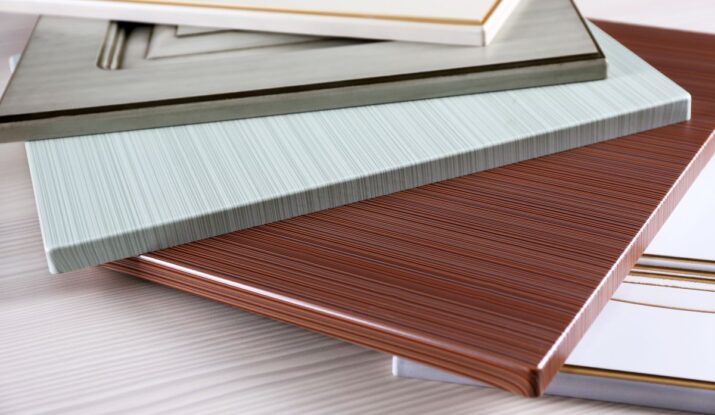
Your kitchen cabinets still work fine. But the finish looks old, the doors feel dated, and the color makes the whole room look dark.
That’s where cabinet refacing materials come in. Instead of tearing out your whole kitchen cabinet setup, you keep the cabinet boxes. You only replace the outside surfaces, cabinet doors, and drawer fronts.
It’s a smart move. But before you buy a single sheet of material, you need to know what you’re actually buying. Cabinet refacing materials are not all the same. Some hold up for 20 years. Some start peeling in five. Some look great online but disappoint in real kitchens.
This guide breaks down the best materials for cabinet refacing. What do they cost? How do they hold up? And what works best for different homes?
Quick Answer: Four main cabinet refacing materials are wood veneer, PSA (pressure-sensitive adhesive) veneer, plastic laminate, and thermofoil. Wood veneer is real wood. Sliced thin in about 1/40 inch. It looks the most natural. Plastic laminate is the toughest. It handles moisture best. PSA veneer is the easiest to install yourself. The right pick depends on your budget. The frequency of using the kitchen. And whether you’re hiring a service or doing it yourself.
What Exactly Are Cabinet Refacing Materials?
Refacing is not painting. It’s not replacing either. It lands somewhere in between.
Your cabinet boxes stay put. You wrap them in new material. Swap out the cabinet doors and drawer fronts. Add fresh hardware and you’re done. The kitchen looks new. The cost is a fraction of full replacement.
The materials you use to cover those boxes — that’s what this whole thing comes down to. You have veneer sheets, laminate panels, edge banding, moldings, replacement doors, drawer fronts and new hinges. If you select the wrong skin, the entire project goes awry much quicker than you’d think.
We’ve walked into kitchens where the boxes were 30 years old and still solid. The material on the outside had just given up. That’s what refacing fixes.
Good to Know: Refacing typically costs 30–50% less than buying new cabinets. Material choice is one of the biggest cost drivers — and one of the biggest quality drivers too.
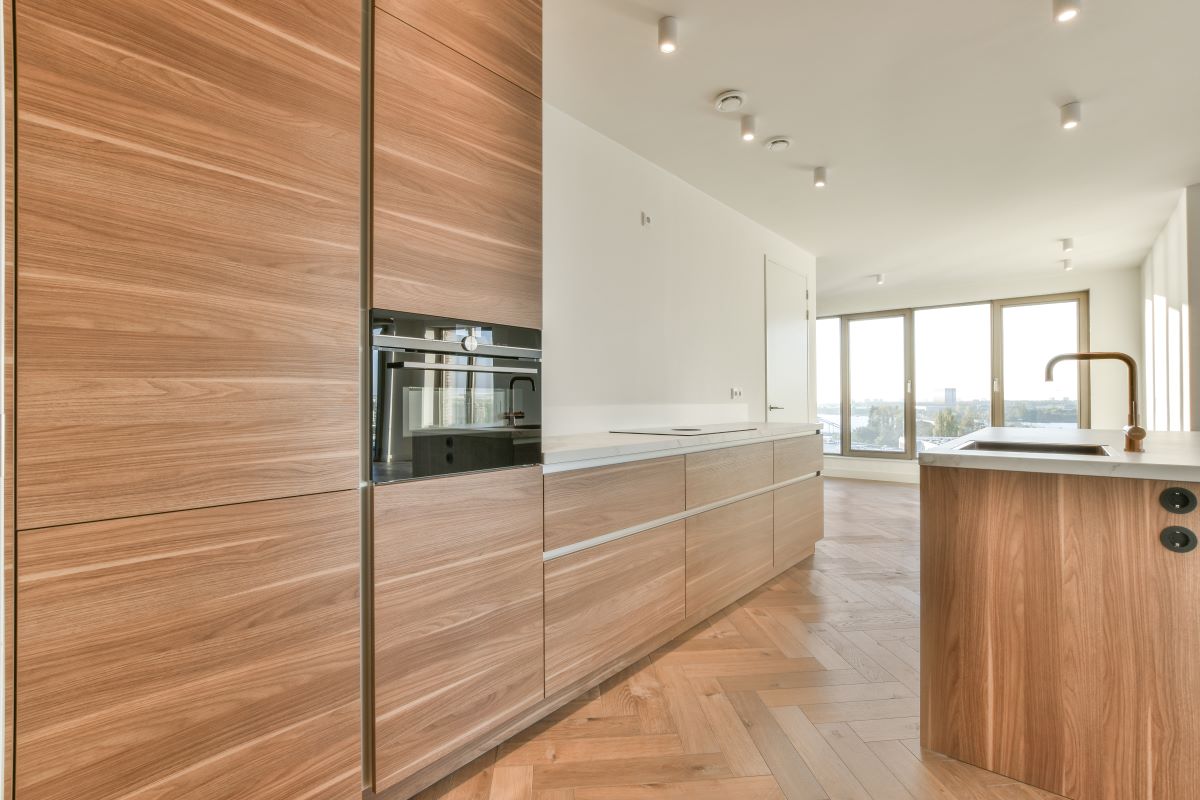
The 4 Main Cabinet Refacing Materials —Thickness, Appearance, and Costs Compared
Here’s a quick look at all four options before we dig in.
| Material | Thickness | Appearance | Best For | DIY-Friendly | Avg. Cost/Sq Ft |
| Wood Veneer | ~1/40 inch | Real wood grain | High-end kitchens | Moderate | $2–$5 |
| PSA Veneer | ~1/40 inch | Wood grain or solid | DIY projects | Yes | $2–$4 |
| Plastic Laminate | ~1/16 inch | Solid or textured | High-traffic kitchens | Moderate | $1–$3 |
| Thermofoil (RTF) | Thin film | Smooth, modern | Budget updates | No | $1–$3 |
Wood Veneer: The Classic Choice for a Real-Wood Look
Real wood. Not printed, not fake — actual wood sliced off a log in thin layers. About 1/40 inch thick. That’s roughly the thickness of two sheets of copy paper stacked together.
Wood veneer bonded sheets comes unglued or pre-glued. Standard sheet sizes are 2×8 feet or 4×8 feet. That’s big enough to cover most cabinet box faces without a seam.
To install unglued veneer, you brush contact cement onto both the cabinet surface and the back of the sheet. Let both sides dry a bit, then press them together. Use a veneer smoothing tool to push out any air. No nails. No holes. Clean finish.
The reason people choose wood veneer over everything else is simple — you can stain it. Match your trim, match your floors, match whatever else is going on in the kitchen. That kind of control is hard to get with any other refacing material.
What to Watch Out For With Wood Veneer
Moisture is the enemy. Near the sink, near a dishwasher that steams up — veneer edges can lift if they’re not sealed properly. Edge banding on every exposed edge is not optional. Neither is a good topcoat.
The other thing we see go wrong: people stick veneer onto a surface that wasn’t prepped. Contact cement grabs fast. If the cabinet face has grease, dust, or old paint ridges, you’ll lock that stuff under the veneer and you’ll feel every lump when you run your hand across it. Sand it flat. Wipe it clean. Then glue.
Pressure Sensitive Adhesive Veneer: The Easy DIY Option
This is the one most first-timers grab, and for good reason.
PSA veneer looks like regular wood veneer but it’s got a 3M Pressure Sensitive Adhesive already on the back, under a paper backing you peel off. No separate glue. No mixing, no brushing, no drying time. Peel, press, smooth.
That’s actually the easy part.
The hard part is alignment.
Once PSA veneer touches the cabinet, repositioning is difficult.
Common PSA Veneer Installation Process in Steps
- Clean surface Remove grease and dust
- Measure sheets Match cabinet size
- Peel backing Expose adhesive
- Apply veneer Press evenly
- Smooth surface Remove air bubbles
- Trim edges Use utility knife
Using a veneer smoothing tool helps apply even pressure and removes air pockets.
And there’s another benefit.
No nail holes.
That creates a cleaner finish around stiles, rails, and edges.
Some DIY kitchen refacing kits use PSA veneer because homeowners can install it without special glue.
But honestly, large surfaces can be tricky for beginners.
Pro Tip: Don’t peel the whole backing sheet at once. Work in sections — peel a few inches, press it down, peel more. Once PSA adhesive touches the cabinet surface it grabs immediately.
Plastic Laminates: The Most Durable Refacing Material
This stuff is tough. It’s the same material on countertops and commercial furniture. It’s been around for decades because it works.
Plastic laminates start as layers of Kraft paper. The brown stuff is soaked in plastic resin. Then pressed under heat until everything fuses into a solid sheet. About 1/16 inch thick. It’s hard, smooth and stain-resistant. You can scrub it down with almost anything and it doesn’t care.
Color options are everywhere. Solid whites, grays, wood grain prints, stone looks. Whatever style the kitchen needs, there’s probably a laminate that matches.
Laminate doesn’t bend. It’s stiff. Curved surfaces are out. And if you hit an edge hard enough — a door swings into it, someone drops something — it can chip. That brittleness is the one thing laminate has never solved. On a flat cabinet face it’s fine. On corners and edges, protect it.
Installation takes more care than PSA veneer. You’ll use contact cement, and you’ll need a router or laminate trimmer to get clean edges. Not hard if you’ve done it before. A little tricky if you haven’t.
Not sure which material makes sense for your kitchen? Dr. Cabinet offers free estimates for homeowners across the USA. Visit Dr. Cabinet— tell us what you’ve got and we’ll tell you exactly what we’d use.
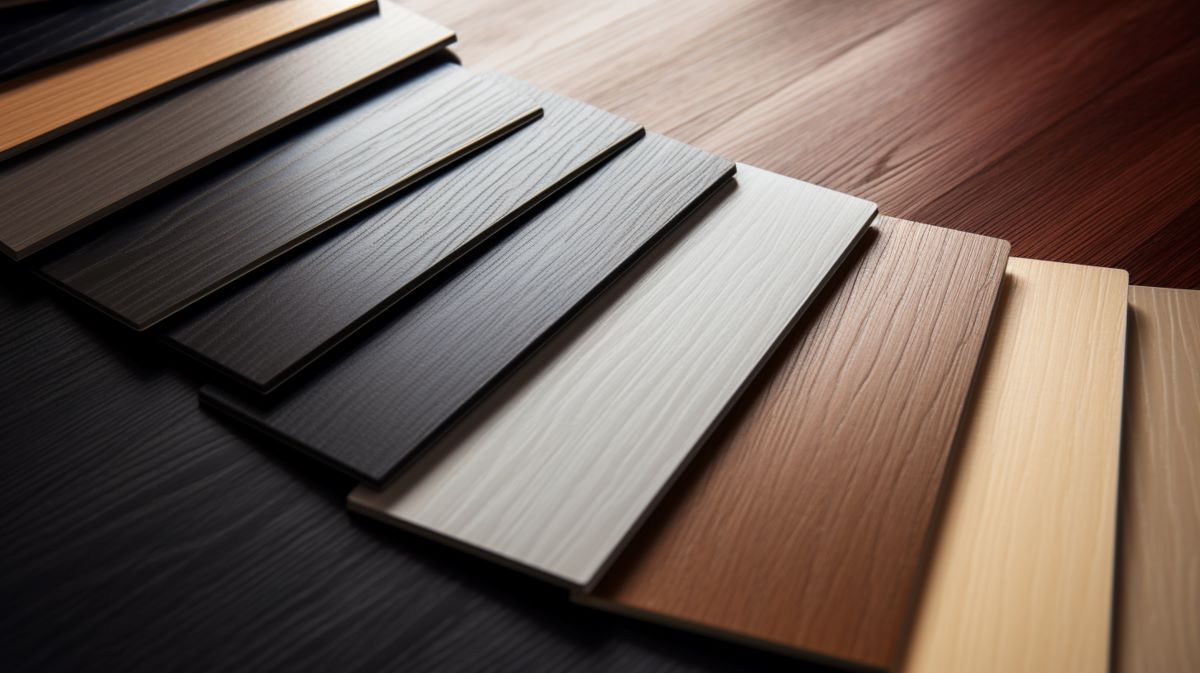
Thermofoil and RTF Veneer: The Modern Low-Maintenance Option
Thermofoil is a vinyl film. It gets heat-pressed onto an MDF or plywood base. Most often you’ll see it on replacement doors, but it shows up as a box-facing material too.
The RTF version — Non-Adhesive Phenolic back 3D Laminate — is what you’d use on larger flat panels. It needs contact cement to go on, and it’s the better pick over PSA-style material when you’re covering a big surface. Stiffer backing means it lays flat instead of bubbling up in the middle.
Pros:
- Looks clean.
- Easy to wipe down.
- Lots of color choices.
Cons:
- Thermofoil does not handle heat well
- The film separates from the base and peels up
If those cabinets are right next to a burner, pick something else.
Cabinet Doors and Drawer Fronts: Don’t Forget These
The veneer on your boxes is half the job. The doors and drawer fronts are what people notice. They’re what you look at every single day.
Replacement doors come in just about every style you can think of.
- Wood doors pair with wood veneer boxes.
- Thermofoil doors go with thermofoil or laminate surfaces.
Measure before you order. Write it down twice. Door sizing is where a lot of DIY jobs fall apart. A door that’s a quarter-inch too narrow looks sloppy. One that’s too wide won’t close right. Take your time with the tape measure.
While you’re at it, upgrade the hinges. Soft-close hinges are not expensive and they make a real difference. No more slamming. No more chipped door edges from years of hard closes.
DIY Kitchen Refacing: What Cabinet Refacing Supplies You Actually Need
Refacing yourself is completely doable. Here’s what you’ll need to pull it off:
Utility knife
Veneer smoothing tool
Contact cement
Pressure roller
Sandpaper
Trim router
Measuring tape
Heat gun
Adhesive sheets
Replacement hinges
You’ll also need to order replacement doors and drawer fronts that accurately match your cabinet sizes.
The tools are cheap. The time is not.
A full kitchen takes most people a full weekend, sometimes longer. Work slow and steady, and you keep more of your budget.
But if uneven edges or loose joints bother you, hire someone. They move fast, and the final look is tighter.
Dr. Cabinet Advice: Prep is important. Don’t skip cleaning and sanding. Don’t rush it.
Laminate vs Wood Veneer: Which One Should You Choose?
Wood veneer if you want real wood. Laminate if you want something that can take a hit.
A little more detail: Wood veneer offers you a touch of finish that can be stained, sanded and toned to your home design. As wood, it looks like wood. It is a bit more expensive and takes a bit more work to install, but can really look nice in the right kitchen.
For the family of 3 kids and 2 dogs, plastic laminate is the choice. Accepts moisture, cleans with a damp rag, and will not dent easily. The natural grain is gone but you get something that will still look good in 15 years.
A side-by-side to help you decide:
| Factor | Wood Veneer | Plastic Laminate |
| Look | Natural wood grain | Printed or solid color |
| Durability | Good with a proper finish | Excellent |
| Moisture Resistance | Moderate | High |
| DIY Difficulty | Moderate | Moderate to hard |
| Cost Range | $2–$5 per sq ft | $1–$3 per sq ft |
| Can Be Refinished | Yes | No |
| Best Kitchen | Formal or custom look | Busy family kitchen |
How Refacing Compares to Replacing New Cabinets
New kitchen cabinets mean full replacement. You’re looking at $5,000 on the low end and $25,000 or more on the high end. Refacing with decent materials usually runs $1,500 to $6,000 for the same space. This method is more affordable.
The boxes stay. You don’t rip anything out. Your kitchen stays usable during most of the job. And if the work is done right, nobody walking into that kitchen is going to know you didn’t replace everything.
Refacing works best when the boxes are solid and the layout suits how you cook and live. If a wall needs to move or the boxes are rotted through, that’s a different conversation. But most of the time? The bones are fine. It’s just the surface that gave up.
Refacing Makes Sense If:
- Cabinet boxes are strong
- Layout still works
- Water damage is minor
- You want lower costs
- You want faster installation
Replacement Makes Sense If:
- Cabinet boxes are weak
- Layout feels cramped
- Mold or rot exists
- You need more storage
- Plumbing or electrical changes are planned
Frequently Asked Questions
What is the best material for cabinet refacing?
It comes down to money and wear. Wood veneer looks natural and takes stain well. Plastic laminate handles water, mess, and heavy use better. For DIY, PSA veneer is the easiest—no extra glue. Ask a contractor to peek at your kitchen. Ten minutes, and you’ll know what fits.
Can I reface my cabinets myself?
Yes. PSA veneer works great for beginners. Peel, stick, smooth down. The hard parts? Clean edge cuts and good prep. Wood and laminate need contact cement and a steady hand with a trimmer. Plan for a full weekend. Don’t skip the sanding.
How long do refacing materials last?
Good stuff lasts 10 to 20 years in most kitchens. Plastic laminate usually holds up the longest. Wood veneer can match it if sealed right. Thermofoil is the weakest—heat near a stove can make it peel in 7 to 10 years. Pay a pro, and everything lasts longer.
What is pressure sensitive adhesive veneer?
Real wood veneer with sticky backing from 3M. Peel off the paper. Press it down. Smooth it out. No glue needed. It sticks on contact. DIYers like it because it skips the hardest step of regular veneer.
Is cabinet refacing worth it over replacing cabinets?
Most times, yes. You pay 30 to 50 percent less than full new cabinets. Finish in days, not weeks. Visitors can’t tell the difference. Works well if your boxes are solid and the layout is fine. Damaged boxes or a bad layout? Then maybe replace.
What tools do I need for DIY cabinet refacing?
Utility knife. Straight edge. Veneer roller or a smooth block. Tape measure. Sandpaper—120 and 180 grit. A brush or small roller if you’re using contact cement. Laminate also needs a router with a flush-trim bit. Most tools cost under $50 at any hardware store.
The Bottom Line on Cabinet Refacing Materials
Cabinet refacing materials come down to four choices. Wood veneer, PSA veneer, plastic laminate, thermofoil. Each one works — but only in the right situation.
If you’re handy and want a simple project, start with PSA veneer. If you want the kitchen to look sharp for the next 20 years, wood veneer or laminate installed by someone who does this every day is the better route.
Dr. Cabinet has worked on kitchens all across the USA. If you want a real opinion on what material suits your space before you spend anything, reach out. We’ll take a look and give you a straight answer.