
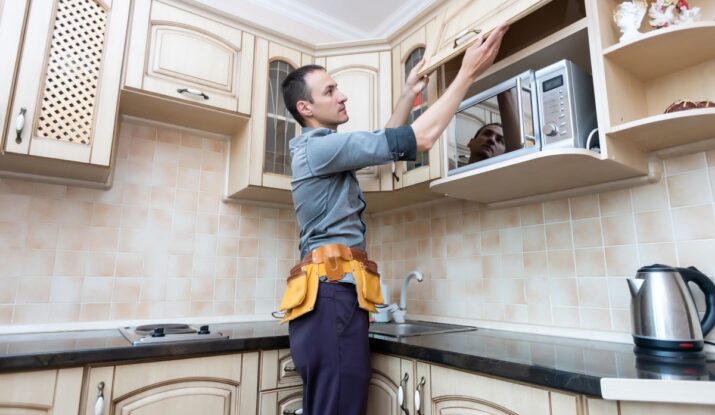
Most upper kitchen cabinets are 12 inches deep. But that’s not always the right choice for every kitchen. The depth of upper cabinets affects many things in your kitchen. For example, how much you can store. How your kitchen looks. Even how comfortable you feel when you’re working. Balance is everything here. If you go too deep, your kitchen can feel cramped. If it is too shallow, you lose valuable storage space.
In this guide, you will discover all you need to know about how deep are upper kitchen cabinets. Their standard depth. How to customize them. How they differ from lower cabinets. And you’ll also learn about some of the practical design considerations to take into account.
Ready to dive in? Let’s bginn with how deep are upper kitchen cabinets.
Standard Depth of Upper Kitchen Cabinets
How Many Inches Should Upper Cabinets Be?
Most upper kitchen cabinets have a depth of 12 inches. This size is most common throughout many households as it offers adequate storage capacity for utensils such as plates, cups, and other small items in the kitchen.

Can Upper Cabinets Be More Extensive?
Indeed, upper cabinets can be deeper if necessary, though they are usually shallower than lower ones. It is possible to get deeper cabinets of 15-inch or 24-inch deep to accommodate larger items in the home. Custom-built, deeper cabinets are a good idea for larger kitchens or for those needing additional storage capacity.
Why is Depth Important?
Measuring how deep are upper kitchen cabinets is crucial because it determines the floor space you have on your countertops. If cabinets are too deep, they will just make the kitchen look crowded or uncomfortable to navigate through. That is why 12 inches is a standard – it is for storage space and a comfortable working area.
One common mistake in real kitchen projects is to install too deep cabinets for the space. This can make countertops narrow and uncomfortable to use. Especially in smaller kitchens. With proper depth planning this issue can be avoided from the start.
How to Choose the Right Depth?
When picking the depth of your upper cabinets, think about:
- Your kitchen layout: Small kitchens may require low-height cabinets.
- What you’ll store: Bigger utensils might require deeper drawers for instance deeper cabinets may be required for larger cookers.
- Your style: Deep cabinets can add more impact and can be a great idea but they can sometimes disrupt the design.
It is always important to consider the depth of your upper cabinets for effective planning of the kitchen to be both stylish and functional.
Common Mistakes When Choosing Upper Cabinet Depth
Wrong cabinet depth can affect both functionality and design. Here are some common mistakes to avoid when choosing it:
- Installing deep cabinets in small kitchens
- Ignoring head clearance while working on countertops
- Not considering lighting under cabinets
- Choosing depth based only on storage, not usability
- Matching upper and lower cabinets without planning space
A balanced approach always works better than simply going deeper for more storage.
Customization and Semi-Custom Options
What Are Semi-Custom Cabinets?
Semi-custom cabinets are a little different as some standard dimensions can be altered and the design changed to fit the kitchen better. One benefit of semi-custom cabinets over stock cabinets is that the dimensions such as depth, height, and width can be adjusted according to the users’ desire. For instance, you may opt to extend the depth of your upper cabinets from the regular 12 inches up to 15 inches or even more.
Why Choose Custom or Deeper Cabinets?
Cabinets with depths greater than shallow ones are 24 inches deep, thus providing more storage as compared to other kitchens. They are ideal for holding bigger things like large bags of popcorn or pasta, trays used in serving or even small gadgets like mixers. Custom cabinets also give you the opportunity to choose a kitchen layout that will be coordinated with other rooms in the house.
Benefits of Customizing Upper Cabinet Depth
- Maximized Storage: Shallow cabinets are available for those who do not have enough space on their walls or ceilings for deeper ones that will accommodate greater items.
- Improved Functionality: It is, therefore, important to be able to customize the depth of the cabinet for easier access and organization.
- Enhanced Aesthetics: Semi-custom and custom cabinets enable you to accomplish an upscale, fully tailored kitchen.
When to Consider Semi-Custom Options
- If you have a peculiar kitchen design, with irregular kitchen cabinet sizes and shape of the floor area.
- When it is time to get a deeper pantry or garage storage or to get more storage space in general.
- If you wish to optimize the space of a kitchen with high ceiling height.
Semi-custom or custom cabinets will allow you to have a kitchen that meets your needs but is also uniquely yours.
Upper and Lower Cabinet Depth Comparison
Difference Between Upper and Lower Cabinets
Upper cabinets are normally 12 inches deep while lower cabinets also known as base cabinets, have 24 inches depth. The only big difference lies in their purpose and position in the kitchen area. Upper cabinets are intended for smaller things that do not require much height, lower cabinets are intended for storing pots, pans, and appliances, and other large things.

Can Upper and Lower Cabinets Have the Same Depth?
In most cases, lower cabinets depth depends on how deep are upper kitchen cabinets. Usually, they are not the same depth: However, some homeowners decide to make them have the same depth, which is common in modern or minimalist designs. Another factor that can cause upper cabinets to appear different from lower cabinets is if the depth of the upper ones is equal to the depth of the lower ones and this results in a sleek appearance. Remember, however, that deeper upper cabinets limit the countertop area and make a kitchen seem even more confined in a small kitchen.
Advantages of Matching Cabinet Depth
- Uniform Design: Extensive upper and lower cabinet alignment is aesthetic, and gives the interior a more contemporary appeal.
- Additional Storage: Deeper upper cabinets offer additional storage for bulky items.
- Bold Aesthetic: Some like the look of having low upper cabinets which gives a dramatic look, especially in kitchens with high ceilings.
Disadvantages of Matching Cabinet Depth
- Reduced Workspace: Deeper upper cabinets could give a cramped appearance to the kitchen if there isn’t enough counter space.
- Increased Cost: Additional customization of both upper and lower cabinets may cost more than if one uses standard measurements.
Even if you can have upper and lower cabinets with equal depth, it is crucial to pay attention to the size and organization of the kitchen. Matching depths are appropriate when the kitchen is large enough to afford space for numerous and large appliances but may not be so appropriate where every inch of counter space is needed in a small kitchen.
Specialized Upper Cabinets (Quick Overview)
Some upper cabinets are designed differently based on kitchen needs:
Corner cabinets: Help utilize unused space. They may vary slightly in depth for accessibility
Over-the-range cabinets: Often deeper (15–24 inches) to fit microwaves and ventilation systems
These variations depend on function. Standard cabinets remain around 12 inches deep.

Benefits of Specialized Upper Cabinets
- Increased Storage: These cabinets are useful for storing such items as tall appliances or cleaning equipment, for instance.
- Customization: It enables you to optimize areas which may be hard to use such as corners or small spaces between furniture.
- Improved Functionality: Specialized upper cabinets can add organization to your kitchen if designed appropriately.
Adding specialised upper cabinets makes your kitchen to be more functional as well as aesthetically appealing and they are able to meet your storage requirements.
Pro Tip: Balance Depth with Comfort
Always test how far you need to reach when using your countertop. If upper cabinets are too deep, they can block your movement. It can make it harder to work comfortably.
A good rule is to prioritize ease of use first. Then maximize storage.
Deciding on the proper depth of the kitchen.
Consider Your Kitchen Layout
An important factor in determining the depth of your upper kitchen cabinets is the design of your kitchen. For example, if you have a small kitchen, then you can keep the depth normal at 12 inches so as not to overfill the area. However, if you have a large kitchen or, especially, one with greater ceiling height, it is better to use deeper cabinets (for example, 15 or 24 inches deep) to achieve better proportions and provide additional storage space for big things.
Functionality vs. Aesthetics
What do you do in the kitchen? For those who require sufficient space for pots, pans or even canned goods, deeper upper cabinets could be ideal. Nonetheless, if you prefer to have your kitchen free from that closed, claustrophobic feeling, shallow cabinets may be the way to go. As with any type of countertop, the depth you choose will affect how practical and visually appealing your kitchen will be.
Maximize Storage Space
To get the most out of the available space, if your main goal is to save on storage space, opt for deeper upper kitchen cabinets than the 12 inches in width. Deeper cabinets are useful for storing larger utensils, big plates or mugs, or bags of rice, beans, and pasta. In cases where space in the kitchen is a problem, low-height base cabinets and wall cabinets are more advisable to give the room a more spacious and free-flowing feel.
Ceiling Height Matters
Ceilings are another aspect that can influence your decision; especially their height. If you have high ceilings, then you may think of getting tall cabinets which go all the way to the ceiling and provide you with more storage space and style. Cupboards that go to the ceiling give the kitchen a built-in appearance and allow to use the wall space more effectively.
Test for Accessibility
It does not matter how deep are upper kitchen cabinets, they have to be easily accessible. Make sure that the cabinets are not too deep to allow easy access especially for persons with some degree of physical disability in an attempt to reach towering shelves. Use pull-down or pull-out for the deeper cabinets in order to get maximum use of the space without making it difficult to access.
Design Style and Personal Preference
Lastly, choose the depth that would fit your kitchen design style. In the case of a more traditional or a more classic style, shallow upper cabinets could be the best solution. If you want a more modern or even daring look, deeper cabinets can give that illusion.
Paying attention to your kitchen layout, storage requirements, and design, you can choose the optimal upper cabinet depth that combines functionality and aesthetics.

Frequently Asked Questions: How Deep Are Upper Kitchen Cabinets
Are all upper cabinets 12 inches deep?
No, upper cabinets do not always measure 12 inches deep. Usually measuring 12 inches, the standard depth of top kitchen cabinets can be increased to 15 inches or 24 inches depending on design and storage space demand.
How deep are overhead kitchen cabinets?
About 12 inches, the depth of overhead kitchen cabinets is likewise the conventional deep upper cabinets. Still, depending on the kind of design and application, they can be deeper and average 12 to 24 inches.
Can upper and lower cabinets have the same depth?
Indeed, top and lower cabinets can have the same depth; this is not a common observation though.
What is the depth of the upper garage cabinets?
The garage plan and needed storage capacity determine the height of the upper garage cabinets. Usually, with a conventional depth between 12 and 15 inches, garage upper cabinets are one inch or two deeper than kitchen upper cabinets
Conclusion
Knowing how deep are upper kitchen cabinets can help you to maximize storage and design during your kitchen remodeling. Though you can choose deeper cabinets, say 15 inches or 24 inches, if necessary, upper cabinets typically have a conventional depth of 12 inches. Actually, the full kitchen cabinets and cabinet doors help to define the practical and aesthetic appeal of the kitchen.
The correct depth and arrangement of your cabinets allow enough room for all of your kitchen utensils without overwhelming the space or the area.
If your upper kitchen cabinets need adjustments or repairs, explore our cabinet repair service at Dr. Cabinet. Our team can help you improve your cabinets’ functionality and appearance. Contact us today to discuss your kitchen cabinet needs.