
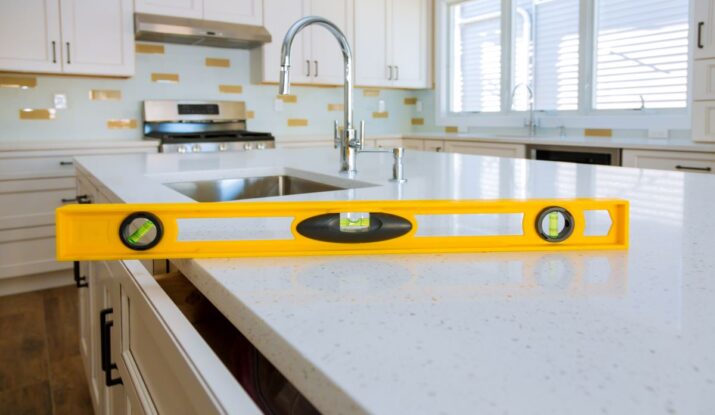
Ok, let’s talk about your kitchen. You’re probably thinking in terms of the colours of the paints, the handles of cabinets and dreaming of how it’s all going to look. But hold on. Before you forget in those samples, we need to chat about something that really makes your kitchen tick: the countertops. And not just in the way they look, but the way they’re sized. The difference between an attractive kitchen and one you wish to use on a daily basis is nailing down of the standard kitchen countertop size.
Think about it. This is where you’ll chop up vegetables and spill coffee and help with homework. Get the size wrong, and you’re looking at a sore back or cabinets you can’t quite open. And get it right, and everything just . . . flows. This guide will help deconstruct all the boring-sounding (but super important) countertop measurements for you. We’re talking height, depth, how to figure out your square footage. Let’s Make Sure Your new countertop is not just a pretty face but your kitchen’s new best friend.
Why the Standard Kitchen Countertop Size is the Best Place to Start
So, are these “standard” sizes just a boring one-size fits-all-trap? Not really. Think of them more like you would a tried and true recipe. They work. They’ve been tested in the millions of homes and for good reason. Sticking right to the standard kitchen countertop size will ensure that your kitchen not only feels right, but works with your other appliances, and will even be a plus if you ever sell your house.
The Resale Value Factor
Going wild with custom countertop dimensions is cool but can backfire sometimes. Imagine a future buyer walking in and wondering why the counters are quite so weirdly high or low. Most homes are constructed on these common numbers. Sticking to them is a safe play to everyone’s happiness down the line.
Functionality and Flow
The standard kitchen countertop size wasn’t just pulled out of a hat. They’re made so that more people can manage to do their work without straining. They ensure that you have enough room for your coffee maker and toaster, and can easily reach other faucets and equipment. They ensure that the surface is at a comfortable height for tasks like chopping onions, and they allow you to swing your cabinet drawers and doors open without a fight. It’s all about making life in your kitchen easier, not harder.
Breaking Down Standard Kitchen Countertop Size
Time for the numbers. Don’t worry, it’s simple stuff. Knowing these will help you talk the talk with your builder and make smart decisions for your limited space.
Standard Countertop Height Measurement: Finding Your Comfort Zone
You’re gonna be hearing this number, and that’s 36 inches from the floor. That’s the go-to standard countertop height for folks of average height. But your kitchen has to be right for you. So, let’s tweak it.
- Are you under 5’4″? A lower counter, maybe 34 – 35 inches, may save your shoulders.
- Topping 6’2″? Increase it to 38-39 inches and save your back.
- For wheelchair access, things become different. The sweet spot is a little lower, between 28 and 34 inches with specific open space underneath for legs.
Base Cabinet Size – The Recipe to Have Sufficient Space
This one looks like a tricky one, but no. The standard countertop depth is nearly always 25.5 inches. Why that number? It depends on your base cabinet size that tends to be 24 inches deep. That extra inch and a half? That’s your overhang for the front edge. It prevents the messes from running right into your cabinets and it just feels better to grab!
When people say standard countertop width measurements, usually they’re referring to that same 25-26 inch measurements from the wall out. This is an ideal depth where you have enough space for your blender and still space for you to get back without performing a gymnastics routine.

The Ins and Outs of Countertop Thickness
This is all about the vibe. For fancy stuff like granite and quartz the standard countertop thickness measurement is usually 1.25 inches. It feels solid and high-end. Other materials such as laminate tend to be slightly thicker. If you’re dreaming of a super-slim look, just know it’d likely have to have some extra muscle under it in order to not snap.
Kitchen Island Countertop: The Command Center
The kitchen island is the star of the show and the dimensions play by their own rules. This is your chance to get a little creative and create a spot everybody wants to hang out.
Island Depth for More Work Space and Seating
Your main countertops may want to play by the rules, but your island countertop can do whatever. A typical one extends from 27 to 36 inches deep. If you’re all about the cooking, then 27 inches is plenty. But if you want people to sit there and weedle-fozzle you, you’ll have to go larger – like, 36 to 48 inches – so that you’ve got more room behind those knees.
The All-Important Overhang
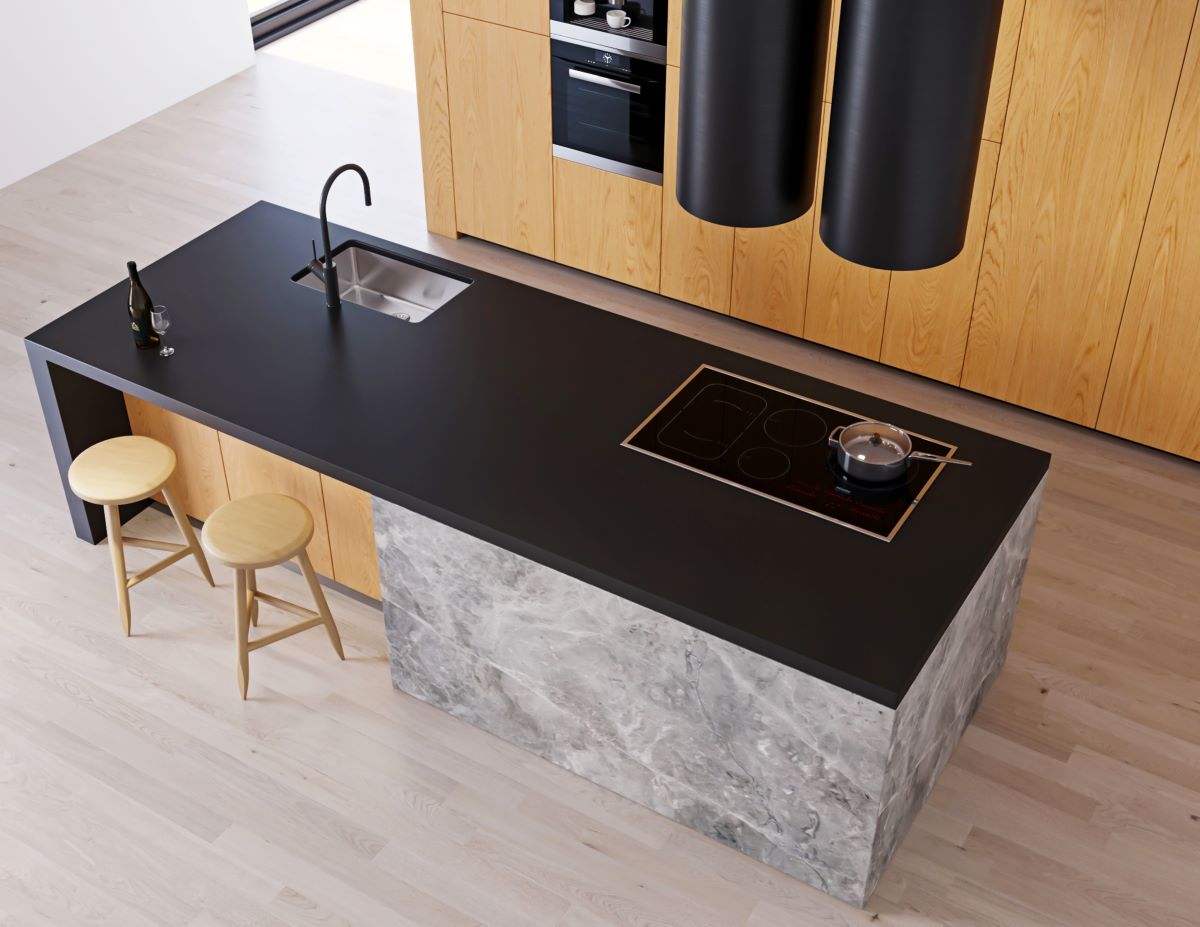
Putting stools at the island? You need an overhang. For people to actually sit comfortably you need to give them 12 to 15 inches of legroom. Don’t skip this! And a quick heads up, any overhang that is longer than a foot is going to need some extra support like metal brackets or corbels to hold it up. This is where you get those fancy waterfall islands the stone runs right down to the floor. Looks amazing.
Standard Depth of Bathroom Countertops:
Bathroom countertops are also practical and cosmetic elements in your bathroom design and they are normally made of marble and granite. The thickness of the countertops of the bathrooms is normally standard, that is, 18 inches in depth (or 46 cm).
How to Measure for Your New CounterTop
Before you fall in love with a slab of stone, you gotta know how much you need. Getting your countertop standard measurements right is a humongous deal for your wallet and for a smooth install too.
Calculating Your Total Square Footage
Get out a tape measure and perhaps a calculator. You need to measure each and every countertop sections.
- For every part, measure how long the part goes on the wall, and how deep it goes out.
- For each section multiply the length by the depth. That gives you the area in square inches.
- Add all those areas together.
- Take that large number and divide it by 144. Boom, you’ve got square feet.
That last square foot is what the stone fabricators will use to tell you what the price will be. And don’t forget for the holes they’ll have to cut for your sinks and stove!
A Pro Tip: Draw a Diagram
No, really, just draw it. Sketch a basic view from the top of what your kitchen design will look like. Mark how long each counter is, where the fridge and the sinks live. This little drawing will save a ton of headaches to you and your installer.
Selecting Countertop Material: Dimensions and Durability Meet
The stuff you pick can have a little change on the game. It impacts the appearance, duration of its life, and, of course, the price tag.
Quartz Countertops: The Engineered Star
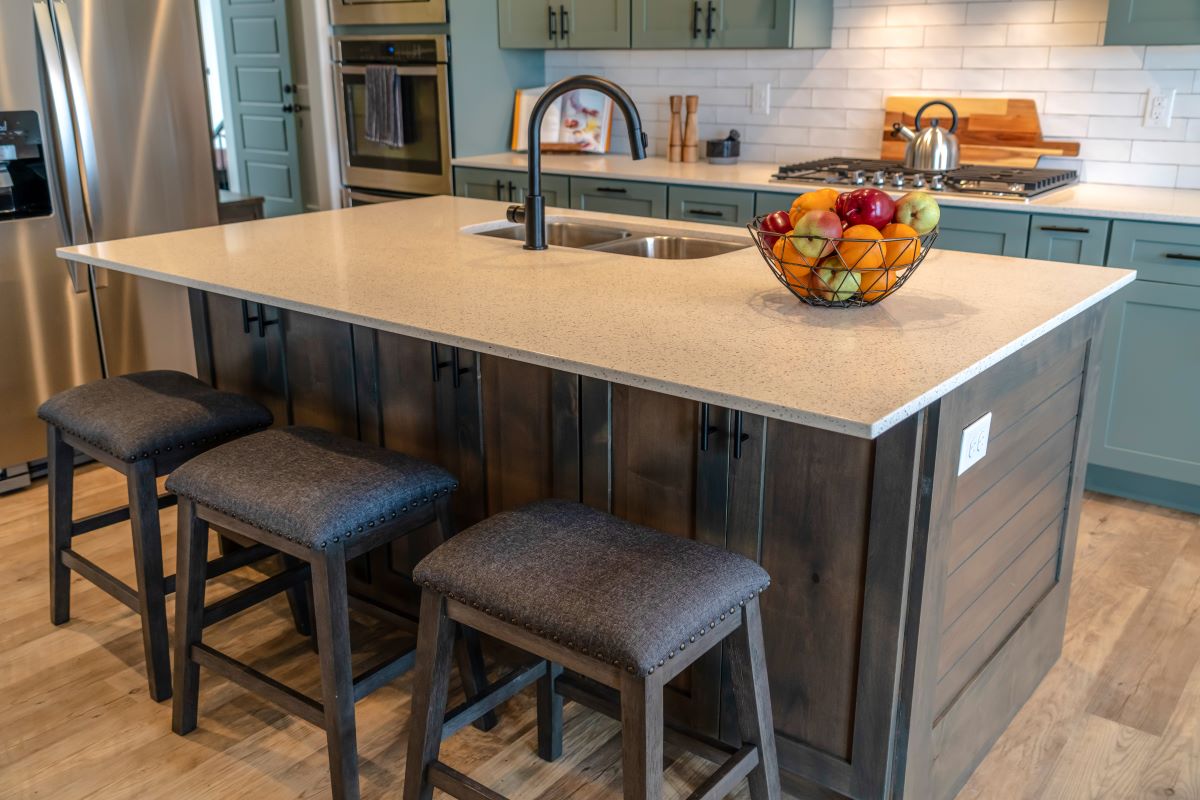
The quartz countertops are famous due to several factors. They are non-porous so the stains and germs will not sink in. Spill some wine? Just wipe it up. They’re also crazy strong — often tougher than natural stone — and companies typically warrant them for a long, long time. This strength allows stone fabricators to produce those lengthy counter sections of beautiful countertops with little to no seam.
Granite Countertops: Nature Piece Statement.
Granite brings a unique and natural beauty in your kitchen. It’s tough and can handle heat but you do have to shield it now and then to safeguard it from stains. Because every slab is unique, the installers must be clever in how they cut the countertop pieces to make the most of the countertops in terms of the patterns revealed by the stone.
When to Break the Rules: Individualizing Your Countertops Sections
The standard kitchen countertop size is a perfect starting line and not a finish line. Your house is your house so make it work for your life.
Ergonomic Height for your Lifestyle
If you reside in your kitchen, a custom height can change everything. Try out different heights before deciding. The aim is to prevent the aches and pains. It’s the same thing with accessibility; following the ADA guidelines for height and knee space is just going to make your kitchen a better and more welcoming space for all your friends and family.
Deeper Countertops for the Foodie
Got the room? Use it! To create a small lift to the countertops in order to put them into deeper depths (consider 27-28 inches) along the sides of your stove, will give you an ideal place to place your grocery bags and meal preparation. Only have to ensure that it is not in the way or giving you difficulty in opening the door of the oven.
Navigating Accessibility and Architecture Codes
Whether you need to or simply want to make your kitchen accessible is smart. This is recommended between 28 and 34 inches as the counter top height of Americans with Disabilities Act (ADA). Remember, always, consult your local building codes before you begin to tearing things out. Being safe is better than sorry.
Frequently Asked Questions (FAQs)
Q1: What should be the standard overhang for counter top?
For counters against the wall it is typically about 1.5 inches overhang. It's just enough to keep drips off of cabinets. But for an island where people sit, you need a lot more -- 12 to 15 inches -- so folks are not bumping their knees.
Q2: Is it possible to have varying heights of countertops in my kitchen?
You sure can. It's known as a multi-level island. It's a great trick. You may have one side raised up to eat your breakfast (some 42 inches) and the other side flat to roll out the dough and other food preparation.
Q3: How much countertop space do I need beside my sink and stove?
You want at least 15 in. of clear counter on each side of the stove. It's a safety thing - a place to slide a hot pot. Next to the sink, the fact that there's some clear space to one side at least is key when it comes to a drying rack or just putting down wet things.
Q4: Is 30 inches deep island too deep?
A 30in. deep island is awesome in case of available space. It allows you to get tons of more workspaces. But, if you want seats you should go deeper, 36-inches or more. That way people have legroom, and you still have space behind people.
Q5: What effect does Countertop Thickness have in installation?
Thicker counters are more massive. They might need stronger cabinets underneath, in particular if they stick out far. Thinner counters may require a plywood platforms for extra support. Your installer will be aware of exactly what to do for your material and layout.
Conclusion: Your Perfect Kitchen Countertop Measurement is Waiting
Getting the standard kitchen countertop size right is a combination of smart rules and your personal preferences. It’s about taking what we know works and then bending it to make it work in the way you live. From the standard depth by which you get room to work, to how many square feet determine how much money you spend, every single inch counts.
Ready to make it happen? At Dr. Cabinet, we’re not just cabin techs, we assist you in creating a whole space that looks nice and functions better. We can walk you through all of this from countertop measurements to picking the perfect material. Contact us today for a consultation! Dwell by Me: Let’s create a kitchen for you.