
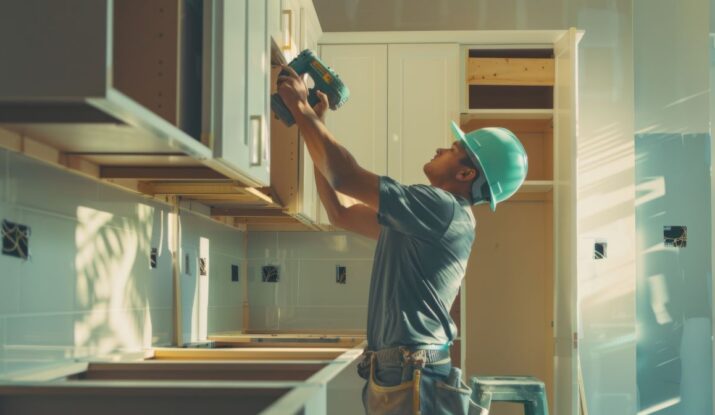
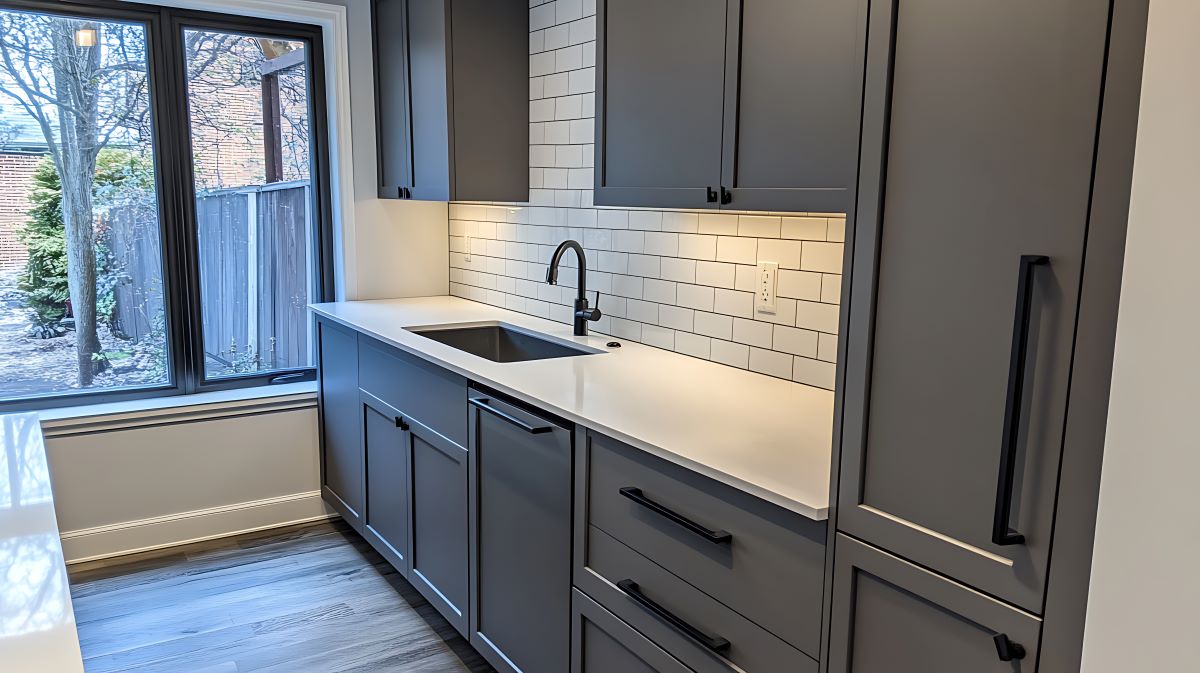
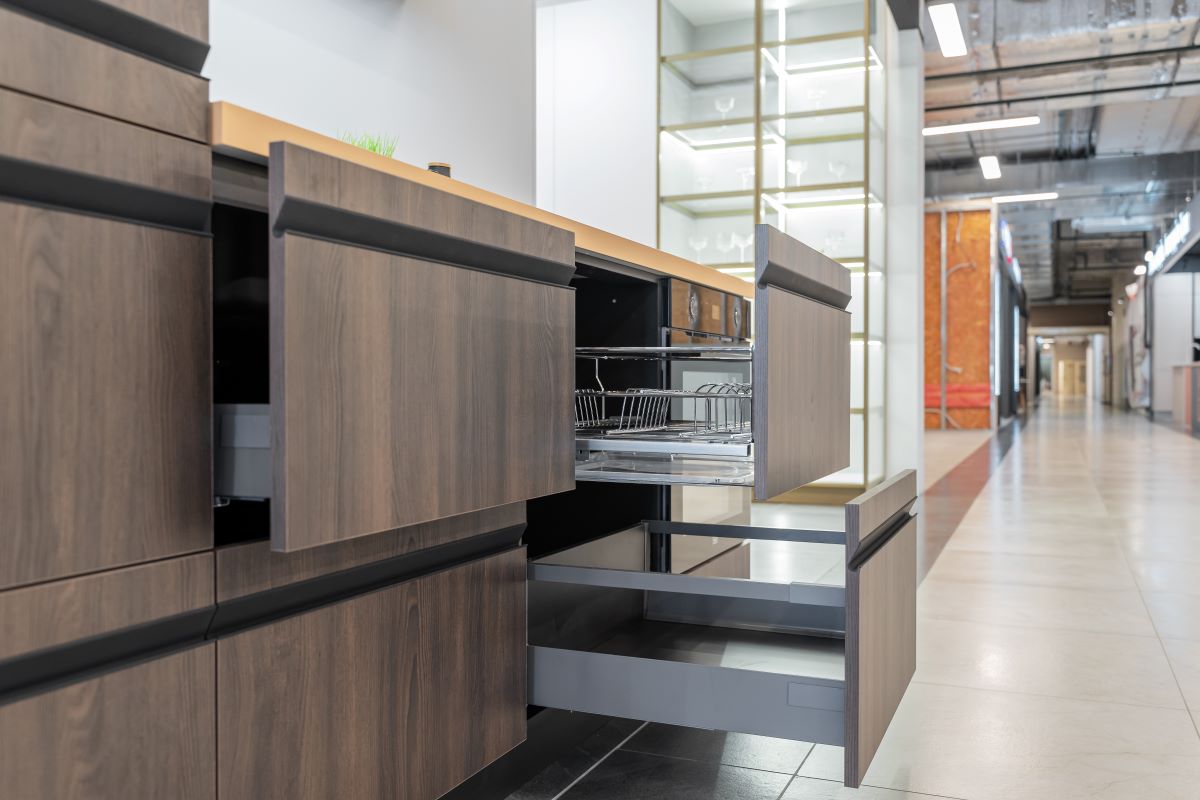
Have you seen those kitchens online? I’m talking the really, really good ones. You’re just scrolling and bam—there it is. The perfect kitchen. And your eyes just go straight to the cabinets. They’re so smooth. Like, weirdly smooth. No brush marks, no weird texture, just… perfect. That’s what they call a factory finish. It’s that crazy professional coating that seems about as easy to do at home as building a rocket ship. This step by step guide will show you how to get factory finish on cabinets without leaving your wallet drained by the process!
Learning how to get factory finish on cabinets is something you can actually do. It is not always simple- it needs time, the necessary tools and hard work, and a no-cutting corners approach. Are you ready?
What is a “Factory Finish,” Anyway? And Why You Want It.
What Makes a Professional Finish Special
- It’s done in a perfect environment. Factories use sealed, dust-free rooms.
- They use professional sprayers. This applies a super fine, even mist of paint.
- The result is a glass-smooth surface. No brush lines. No roller texture. Just perfectly smooth.
- It’s built to last. The finish is incredibly tough against scratches, moisture, and daily use.
The Problem with a Typical DIY Job
- You can always see the marks. Brush strokes and roller stipple are a dead giveaway.
- The surface often feels bumpy or uneven to the touch.
- The paint chips and wears down quickly, especially on cabinet doors and handles.
- It just looks “painted cabinet doors” instead of looking like it was made that way.
Our Goal
- We want to beat the typical DIY look.
- The target is a finish so good, your friends will ask if you bought new cabinets.
- This is the core of the project: learning how to get factory finish on cabinets.
- It’s not just about color. It’s about creating a hard, professional-quality surface.
How to Get the Professional Finish
Let’s talk about the part everyone tries to skip – the preparation work. But here’s what they don’t show you on those quick DIY videos: the prep work is what makes or breaks your entire project.
Here’s the reality: painting is the easy part. The real work happens before you ever open a paint can. This is where we turn those old cabinets into a perfect blank slate. The time you spend here determines whether your finished cabinets look like they came from a factory or from a weekend warrior’s garage.
Think of it this way – every minute you invest in proper prep means your finished product will look that much more professional. This isn’t just painting – it’s creating a foundation that makes your paint job actually look like it’s supposed to. Here is the breakdown of the process with real tips:
Step 1: Takedown Cabinet Doors
Begin by taking apart your cabinets.
- Pull off all the doors: simply slide them out.
- Unscrew (or pull out) the drawer fronts: these come off with ease, depending on your model.
- Disassemble the hardware: hinges, handles, knobs – unscrew them.
By doing this it allows you to view all the surfaces and you get a clean canvas to paint or stain. Everything will appear sharp and professional after reassembling. As you remove them, get a roll of painter’s tape and a sharpie and label everything. A small piece of tape on the back of a door with a number or a description like “upper left corner” will save you a massive headache later. Trust me on this.
Step 2: The Deep Clean – Removing Grease and Grime.
A thin, invisible film of cooking grease, dust and dirt covers your kitchen cabinets, more so, your sinks. When you paint over this, you will not get your paint adhere to and this will probably peel off in future. You must hack through that dirt.
- Apply a powerful degreaser such as TSP (Trisodium Phosphate) in warm water.
- Wipe all surfaces–the cabinet boxes, the doors, the fronts of the drawer–wipe it down with clean water.
- Let it all dry completely. To give your paint permanence, this is a step that is done.
Step 3: The Repair Work – Fixing Flaws with Wood Filler
Now, inspect all your surfaces. See any dings, dents, or deep scratches? How about the old holes from the previous hardware? This is where wood filler comes in. For bigger dings, a product like Bondo can be a lifesaver. Fill every imperfection, let the filler dry fully according to the package directions, and then sand it smooth. This makes all the difference between an “okay” job and a flawless one.
Step 4: The Sanding Foundation – Creating a Perfectly Smooth Paint Finish
This could be the crucial stage in the whole process. You just cannot have a smooth finish without a smooth surface to begin with. You do not have to apply a strip of paint to remove the old finish, but you can and must rough it up so that the new primer can have something to adhere to.
- You have to lightly sand all the surfaces that will be painted using 120-150 grit sandpaper. This covers the cabinets boxes, fronts of the drawers, as well as, the side of the cabinet doors.
- What you are trying to do is to de-gloss the old finish to give a somewhat chalky, rough finish, which the primer enjoys adhering to. Be more conscious of any specific areas or corners.
- After you sand everything you will have a ton of dust. Vacuum all crevices and corners, then cover the all over surface with tack cloth. It is an adhesive cloth that gathers all the dust thus the final result is a clean smooth surface which is now ready to be primed.
The Tools of the Trade: Your Secret for a Professional Finish.
The difference between a professional and an amateur paint work is the use of the right tools. Even the finest preparation in the world will not produce a brush stroke unless you use the wrong tools to lay the paint on.
The MVP: Why a Paint Sprayer is a Game-Changer.
A paint sprayer is the friend you need in case you are really serious about learning how to get factory finish on cabinets.
- This is the only significant ingredient in achieving that perfect, factory-like uniform finish.
- A paint sprayer applies a smooth thin layer of paint so evenly without any brushwork or roller marks.
- It penetrates into minute grooves and it gives us that smooth surface we want.
No, no, there is some learning curve. It will be necessary to have some cardboard to practice with, to become familiar with the spray pattern and movement. And you simply have to cover all things in the room with drop cloths to avoid being sprayed. However, when you have it, it changes everything. It is as near as you can get to having a professional factory finish at home.
High-Quality Paint and Primer: That Really Matters
It is not where to use that left-over garage wall paint. You require a good quality paint, which is specially designed with cabinets and trim.
- They are stronger paints that are self leveling, more durable and harder, which means that they smooth themselves out as they dry avoiding imperfections to the greatest extent possible.
- It is also very necessary to have a good quality primer. Primer does several important things, firstly;
- it seals the wood
- secondly; it prevents marking of the wood (such as water spotting, or tannin bleeding of some wood species, such as oak or cherry, leaking through your newly painted cabinets)
- thirdly; it provides a totally smooth, uniform surface on which your topcoat of paint will adhere. A durable finish is possible by using a good primer.
The Supporting Cast: Tack Cloth, Foam Rollers, and More
In case you cannot get a paint sprayer, a high-density foam roller and a nice angled brush are your next best bet in doing the details. The foam roller will flatten out the roughness, but you will need to be extremely attentive to keep a wet line so that you do not leave any marks. Other materials that are needed include:
- Tack Cloth: To wipe down each and every coat.
- Drop Cloths: To keep your floors and counters covered.
- Painter Triangles: Little This one is used to hold your cabinets doors as you do the painting and spray the edges.
The Main Event: Step-by-step Guide to Painting Kitchen Cabinets.
Okay, the preparation is complete, the equipment is ready. Now for the fun part!
This is where you see your vision come to life.
Priming is Key: The Unsung Hero of a Durable Finish
Stir your high-quality primer well. In case you are using sprayer, dilute it as per the instructions of the manufacturer. Put your primer coat over the entire surface of your cabinet doors, drawer fronts and boxes. The trick in this is to use thin and smooth layers. Making it all one thick, gloppy coat. A thick coat will drip, sag, and take forever to dry. Let this first coat of primer dry completely dry.
After it is dry, dust the all over primed area with a fine-grit sandpaper (such as 220 grit) so as to sand off any dust nibs or raised grain. Fresh with your tack cloth. A second primer coat may be required when covering a dark color or a stubborn stain.
The Painting Process: Thin Layers Win the Race
Now for the color! Stir your high-quality paint thoroughly. Just like with the primer, we’re going for multiple coats. This is the secret to a smooth finish. One thick coat will look messy and take ages to fully dry.
- Apply the first coat of paint. Regardless of spraying or rolling /brushing, maintain a wet edge, and work in a methodical manner. There is no need to re-do parts that are beginning to dry.
- Allow this initial coat to dry off until it is no longer damp to the feel–see the can of paint to determine the recommended dry-time.
- When it is ready, sand it lightly again with that fine 220- grit sandpaper and wipe with a tack cloth. This is done to provide a smooth surface to the next coat.
- Now, apply your second coat. You’ll likely see the color and coverage really starting to pop.
- Repeat the process with several coats: let it dry, lightly sand, and tack.
You may need a third coat for perfect, uniform coverage. Patience is everything here. Rushing and not letting coats fully dry is the most common mistake. This meticulous process is the core of how to get factory finish on cabinets.
The Last Shield: Coating a Top Coat of Protection.
A clear top coating is an excellent idea to achieve maximum durability, particularly where it is used in a kitchen or a bathroom. A polyurethane coating that is made of water will provide a layer of protection over your paint work that is water resistant, scratch resistant and even cleaning chemicals. This top coat is to be applied in the same manner, by thin, smooth coats, and dry between applications.
The Finishing Touches: Assembling and Congratulating Yourself.
As soon as the last coat is well dry and cured ( consult the paint can, it may take much longer than dry). Hang your cabinet doors very carefully with your labels serving as a guide. Reattach the drawer fronts. It is now time to put up those new hinges and other hardware you have been staring at. New hardware is jewelry on your cabinets; it is something that makes the difference. Take a step back and see what you have worked hard. You did it! You have only now been informed about how to get factory finish on cabinets, and totally changed your environment.
Considering Cabinet Refacing? A Smart Shortcut to a New Look
So now perhaps you have read all this and thought to yourself, “That is work a lot of work! And you’re not wrong. Cabinet refacing is another fantastic alternative to cabinet repair in case you like the appearance of your boxes but you want something more dramatic, or your doors are irreparable.
Cabinet refacing is a procedure in which a qualified firm such as Dr. Cabinet takes your old door and the fronts of your drawers and uses brand new ones and gives your existing cabinet boxes the new look with the help of a matching veneer on their outside. It gives you an entirely new appearance inside the comfort and the economic advantages of maintaining your present skeleton. It is an amazing method to have a brand new kitchen without dust and time wastage needed in a complete gut job. It is the final work of a professional without the DIY work.
Frequently Asked questions (FAQs)
Q1: How to get factory finish on cabinets without a paint sprayer?
You can get very close! Although a paint sprayer provides the most flawless finish, a high-density foam roller and a fine brush could provide a great finish. That is to do it with a self-leveling paint and to apply several layers, sanding well in-between with a fine-grit sandpaper. The roller marks are harder to prevent, but it is at last possible.
Q2: What is the duration of the overall process of start to finish?
This may be several days, and that is all right. Rushing is the enemy. Prep (cleaning, repairing, sanding) may require one or two days. It takes one or two coats to prime and one needs to wait between coats. One or more coats of paint will be required and each of them takes several hours to dry. And lastly, the top coat requires its drying time. In the case of a complete kitchen, 4-7 working days with overnight drying is possible.
Q3: Which is the most appropriate kind of paint on kitchen cabinets?
Find paints that are specifically marked as cabinets, trim or furniture. These are either acrylic-urethane or hybrid enamel paints. These are tougher, stronger and exhibit good levels of self-leveling. There are such brands as Benjamin Moore Advance, Sherwin-Williams Emerald Urethane Trim Enamel, or others that would be the best to obtain a durable finish.
Q4: Do you have to sand the paint layers between?
Yes, it is highly recommended. Two things are achieved by sanding between coats with a fine (220-grit) sandpaper: it knocks off all the minute dust particles that might have settled on the paint during the previous coat, and it roughens the surface to a level that the following coat will adhere perfectly. And simply be sure to dust off all the dust afterward with a tack cloth.
Q5: I previously painted my cabinets. Is it necessary to peel the old paint?
Not necessarily! Unless the current paint is peeling and chipping off, you do not need to strip it. The thing you need to do is to clean and then lightly sand the whole surface to de-gloss. This provides the new primer with something to hold on to. But when the old paint is peeling off or in poor condition then you can either scrape it off and sand it down to a firm surface or remove it altogether to achieve the best outcome.
Conclusion
How to get a factory finish on cabinets is not a sprint but a marathon. It requires obsessive preparation, good materials and much patience. However, with this step-by-step reference guide, starting with a deep clean and sanding, then multiple thin coats with a proper tool, you can make a beautiful look that will last and last in your kitchen or bathroom and last a long time, at least as far as the eye wants to spend on it. Keep in mind, there is no magic formula of how to get factory finish on cabinets, it is a technique. It is concerning commitment to the process.
Then are you willing to roll-up your sleeves and make your cabinetry look the glow-up they deserve? Should the DIY project seem like a stretch a notch, it should be remembered that the experts in the team of Dr. Cabinet are always willing to assist whether it involves professional painting, complete installation, or a cabinet refacing endeavor that will awe you.